

Search Results
Showing 11 - 20 of 391 results
-
 paperback
Letters and Homilies for Hellenized Christians
A Socio-Rhetorical Commentary on Titus, 1-2 Timothy and 1-3 John
Letters and Homilies Series
by Ben Witherington III
The study of the so-called General or Catholic Epistles has been hampered, argues Ben Witherington, by the failure to properly discern their genre. Several of these "letters" are much better understood as homilies--although, like the rest of the New Testament, they are situation specific. In this first of three volumes, Witherington extends his innovative socio-rhetorical analysis of New Testament ...
-
 paperback
2 Peter and Jude
A Commentary on the New Testament
The IVP New Testament Commentary Series
by Robert Harvey and Philip H. Towner
The miracle of being forgiven is perhaps equaled only by the wonder of also being trusted again. That wondrous experience in the life of Simon Peter ultimately produced remarkable letters, full of warning and hope, solemn instruction and gloriouspromise. Because of that grace in Peter's past, his words in the book of 2 Peter are able to strengthen we who are his brothers and sisters in faith.Jude ...
-
 paperback
2 Peter and Jude
An Introduction and Commentary
Tyndale New Testament Commentaries
by E. Michael Green
The epistle of 2 Peter has had a very rough passage down the centuries," says Michael Green in this commentary. "Its entry into the Canon was precarious in the extreme . . . It was deemed second-class Scripture by Luther, rejected by Erasmus, and regarded with hesitancy by Calvin." And about Jude he says, "We can learn a great deal about a man by listening to what he has to say about himself. Jude ...
-
 paperback
Letters for the Church
Reading James, 1-2 Peter, 1-3 John, and Jude as Canon
by Darian R. Lockett
Biblical Foundations Book Awards Finalist
The Catholic Epistles often get short shrift. Tucked into a few pages near the back of our Bibles, these books are sometimes referred to as the "non-Pauline epistles or "concluding letters," maybe getting lumped together with Hebrews and Revelation. Yet these letters, Darian Lockett argues, are treasures hidden in ...
-
 hardcover
2 Corinthians
New Testament Volume 9B
Reformation Commentary on Scripture
Edited by Scott M. Manetsch
"Therefore, if anyone is in Christ, he is a new creation. The old has passed away; behold, the new has come."
When the Reformers of the sixteenth century turned to this biblical text, originally written by Paul to the first-century church in Corinth, they found truths that apply to Christians regardless of their historical context. For example, Reformed theologian Wolfgang ...
-
 paperback
The Message of John's Letters
The Bible Speaks Today Series
by David Jackman
Immorality inundating the Christian community and gradually eroding the foundations of Christian living. The truth of God incarnate, the atonement, and the bodily resurrection of Christ under attack—even from within the church. These were the problems that faced the Christians of John's day. In a society that scorned the gospel and sneered at godly living, John encouraged Christians ...
-
 paperback
1 and 2 Kings
An Introduction and Commentary
Tyndale Old Testament Commentaries
by Donald J. Wiseman
The book of Kings is a unique source for understanding the history of Israel from the last days of the united kingdom under David to the eventual fall of the kingdoms of Israel and Judah. Presenting Israel's national history from a divine viewpoint, these narratives measure the kings of Israel and Judah not by the mark they leave on secular history, but by their "doing what is right in the Lord's ...
-
 paperback
Mere Theology
A Guide to the Thought of C. S. Lewis
by Will Vaus
Foreword by Douglas GreshamWhat did C. S. Lewis believe about God, Jesus Christ, the Holy Spirit, heaven, hell, creation, the Fall, the forgiveness of sins, marriage and divorce, war and peace, the church and sacraments, masculinity and femininity?Lewis was not a professional theologian, but anyone who has read his writings--whether fiction or nonfiction, essays or correspondence--knows that profoundly Christian convictions ...
-
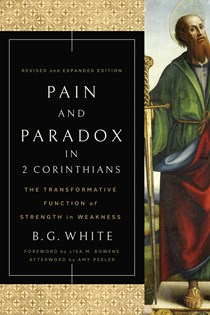 paperback
Pain and Paradox in 2 Corinthians
The Transformative Function of Strength in Weakness
by Benjamin Grant White
Afterword by Amy Peeler
Foreword by Lisa M. BowensPaul's Theology of How Christ Transforms Weakness Into Resurrection Power
What is God doing in our weaknesses? The world may say "nothing," but the apostle Paul says "everything."
The theological wellspring in 2 Corinthians is often overlooked, yet this letter may be one of the apostle's richest and most pastorally attuned writings. At the heart of 2 Corinthians lies ...
-
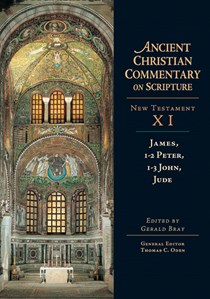 hardcover
James, 1-2 Peter, 1-3 John, Jude
Volume 11
Ancient Christian Commentary on Scripture
Edited by Gerald Bray
General Editor Thomas C. OdenChristianity Today Award of Merit winner
Because the Catholic Epistles focus on orthodox faith and morals, the Fathers drew on them as a means of defense against the rising challenge of heretics. Many of the Fathers saw in these letters anticipatory attacks on Marcion and strong defenses against the Arians. They did so quite naturally because in their ...


