

Search Results
Showing 221 - 230 of 348 results
 Paperback
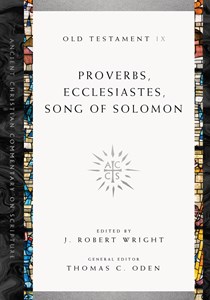
Proverbs, Ecclesiastes, Song of Solomon
Volume 9
Ancient Christian Commentary on Scripture
Edited by J. Robert Wright
General Editor Thomas C. OdenAmong the Wisdom literature of the Old Testament, Proverbs, Ecclesiastes, and the Song of Solomon were all thought by the early church fathers to have derived from the hand of Solomon. To their minds the finest wisdom about the deeper issues of life prior to the time of God's taking human form in Jesus Christ was to be found in these books. As in all the Old Testament, they were ...
 Hardback
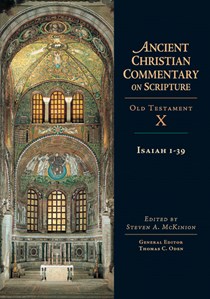
Isaiah 1-39
Volume 10
Ancient Christian Commentary on Scripture
Edited by Steven A. McKinion
General Editor Thomas C. OdenFor to us a child is born,
to us a son is given;
and the government will be upon his shoulder
and his name shall be called
"Wonderful Counselor, Mighty God,
Everlasting Father, Prince of Peace."For the early church fathers the prophecy of Isaiah was not a compendium of Jewish history or theology but an announcement of the coming Messiah fulfilled in the life and ministry ...
 Hardback
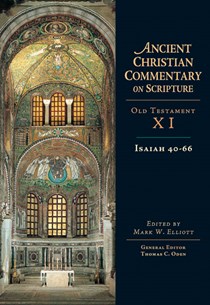
Isaiah 40-66
Volume 11
Ancient Christian Commentary on Scripture
Edited by Mark W. Elliott
General Editor Thomas C. OdenNo book of the Old Testament is more frequently quoted in the New than Isaiah, and no portion of Isaiah is more frequently quoted in the New than the typologically fertile soil of Isaiah 40–66. Still, as interpreted by the fathers, Isaiah presents a message that is far more soteriological than christological, leading readers to a deeper understanding of God's judgment and salvation. ...
 Paperback
Isaiah 1-39
Volume 10
Ancient Christian Commentary on Scripture
Edited by Steven A. McKinion
General Editor Thomas C. OdenFor to us a child is born,
to us a son is given;
and the government will be upon his shoulder
and his name shall be called
"Wonderful Counselor, Mighty God,
Everlasting Father, Prince of Peace."For the early church fathers the prophecy of Isaiah was not a compendium of Jewish history or theology but an announcement of the coming Messiah fulfilled in the life and ministry ...
 Hardback
Jeremiah, Lamentations
Volume 12
Ancient Christian Commentary on Scripture
Edited by Dean O. Wenthe
General Editor Thomas C. OdenJeremiah, the weeping prophet, prophesied for four decades under the last five kings of Judah—from 627 to 587 B.C. His mission: a call to repentance. Among the apostolic fathers, Jeremiah was rarely cited, but several later authors give prominent attention to him, including Origen, Theodoret of Cyr, and Jerome, who wrote individual commentaries on Jeremiah, and Cyril of Alexandria ...
 Paperback
Jeremiah, Lamentations
Volume 12
Ancient Christian Commentary on Scripture
Edited by Dean O. Wenthe
General Editor Thomas C. OdenJeremiah, the weeping prophet, prophesied for four decades under the last five kings of Judah—from 627 to 587 B.C. His mission: a call to repentance. Among the apostolic fathers, Jeremiah was rarely cited, but several later authors give prominent attention to him, including Origen, Theodoret of Cyr, and Jerome, who wrote individual commentaries on Jeremiah, and Cyril of Alexandria ...
 Hardback
Matthew 1-13
Volume 1A
Ancient Christian Commentary on Scripture
Edited by Manlio Simonetti
General Editor Thomas C. OdenThe Gospel of Matthew stands out as a favorite biblical text among patristic commentators. The patristic commentary tradition on Matthew begins with Origen's pioneering twenty-five-volume commentary on the First Gospel in the mid-third century. Inthe Latin-speaking West, where commentaries did not appear until about a century later, the first commentary on Matthew was written by Hilary of Poitiers ...
 Hardback
Matthew 14-28
Volume 1B
Ancient Christian Commentary on Scripture
Edited by Manlio Simonetti
General Editor Thomas C. OdenThe Gospel of Matthew stands out as a favorite biblical text among patristic commentators. The patristic commentary tradition on Matthew begins with Origen's pioneering twenty-five-volume commentary on the First Gospel in the mid-third century. Inthe Latin-speaking West, where commentaries did not appear until about a century later, the first commentary on Matthew was written by Hilary of Poitiers ...
 Hardback
Luke
Volume 3
Ancient Christian Commentary on Scripture
Edited by Arthur Just
General Editor Thomas C. OdenFor the church fathers the Gospels did not serve as resources for individual analysis and academic study. They were read and heard and interpreted within the worshiping community. They served as sources for pastoral counsel and admonition for those who were committed to the Way. Although Matthew and John were generally the preferred Gospels, Luke, because of his particular interests and unique contributions, ...
 Hardback
Romans
Volume 6
Ancient Christian Commentary on Scripture
Edited by Gerald Bray
General Editor Thomas C. OdenChristianity Today Book of the Year
St. Paul's Letter to the Romans has long been considered the theological high-water mark of the New Testament. It was no less regarded by the ancient church, and patristic interpreters have left us an abundance of valuable comment on Romans.
This Ancient Christian Commentary on Romans collects the best and most representative ...


