

Search Results
Showing 71 - 80 of 424 results
 Paperback
New Testament Theology and Ethics
New Testament Theology and Ethics
by Ben Witherington III
All too often, argues Ben Witherington, the theology of the New Testament has been divorced from its ethics, leaving as isolated abstractions what are fully integrated, dynamic elements within the New Testament itself. As Witherington stresses, "behavior affects and reinforces or undoes belief."Previously published as The Indelible Image, Volume 2, Witherington offers the second of a two-volume ...
 Paperback
1-2 Thessalonians
A Commentary on the New Testament
The IVP New Testament Commentary Series
by G. K. Beale
Fascination with the end times is not just a recent phenomenon.The young church at Thessalonica, having taken root during Paul's brief stay there, pondered when the end might come as well. Paul, in order to instruct them more fully, wrote them two letters, which taken together expound the "already-and-not-yet" character of the end times. His instruction and counsel can serve us well today.Throughout ...
 Hardback
1-2 Samuel, 1-2 Kings, 1-2 Chronicles
Old Testament Volume 5
Reformation Commentary on Scripture
Edited by Derek Cooper and Martin J. Lohrmann
"Then David said to the Philistine, 'You come to me with a sword and with a spear and with a javelin, but I come to you in the name of the LORD of hosts.'" (1 Samuel 17:45) Reflecting upon David's victory over Goliath, Reformation translator, theologian and commentator William Tyndale compared it to Christ's victory over sin and death: "When David had killed Goliath the giant, glad tidings came ...
 Paperback
The Lost World of Adam and Eve
Genesis 2-3 and the Human Origins Debate
The Lost World Series
by John H. Walton
Contributions by N. T. WrightChristianity Today Biblical Studies Award of Merit
For centuries the story of Adam and Eve has resonated richly through the corridors of art, literature and theology. But for most moderns, taking it at face value is incongruous. And even for many thinking Christians today who want to take seriously the authority of Scripture, insisting on a "literal" understanding ...
 Paperback
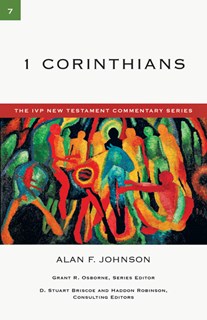
1 Corinthians
A Commentary on the New Testament
The IVP New Testament Commentary Series
by Alan F. Johnson
Upwardly mobile Christians facing radically diverse ethnic, religious, economic and social conditions. The church divided over issues of leadership and authority, sexual morality, gender and worship, marriage and divorce. Sound familiar?First-century Corinth and its challenges were not so different from our own. Yet in the midst of this detailed, practical letter to a church in crisis is found one ...
 Paperback
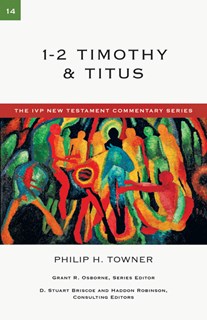
1-2 Timothy & Titus
A Commentary on the New Testament
The IVP New Testament Commentary Series
by Philip H. Towner
Questions about the nature of Christian leadership and authority, attitudes toward wealth and materialism, proper responses to cults, the role of women in the church, and even the validity of the institution of marriage are not new. Paul addressedthese issues in personal letters to Timothy and Titus as leaders of first-century congregations in Ephesus and Crete. What he had to say to them is as ...
 Paperback
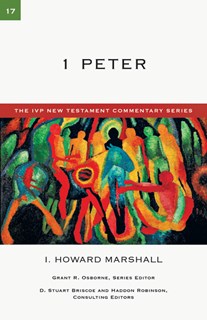
1 Peter
A Commentary on the New Testament
The IVP New Testament Commentary Series
by I. Howard Marshall
- Recipient of a Christianity Today 1992 Critics' Choice Award
As a young church in a hostile environment, Peter's first readers found in his letter encouragement, not just for facing suffering, but for living responsibly in the world as faithful disciples of Jesus Christ. Christians today will also find in Peter's letter a wealth of practical counsel on how to conduct themselves ...
-
Ralph P. Martin
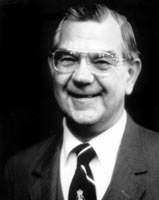
Ralph Martin (1925-2013) was a distinguished New Testament scholar and a significant figure in the post-World War 2 resurgence of British evangelical scholarship. Born in Anfield, Liverpool, England, his early education was interrupted in 1939 by the war, and he was conscripted to work in the coal mines of Lancashire. After the war he pursued ministerial training at Manchester Baptist College and in 1949 earned his B.A. at the University of Manchester. In 1963 he completed his Ph.D. at King?s College, University of London. In 1969 Martin joined the faculty of Fuller Theological Seminary in Pasadena, California, where he would serve as professor of New Testament from 1969 to 1988, and director of the graduate studies program beginning in 1979. He resumed his teaching there in 1995 as Distinguished Scholar in Residence. Throughout his academic career he stayed involved in preaching, teaching laypeople and other pastoral ministry. He was the author of numerous studies and commentaries on the New Testament, including Worship in the Early Church, the volume on Philippians in The Tyndale New Testament Commentary series, and 2 Corinthians and James in the Word Biblical Commentary, for which he also served as New Testament editor.
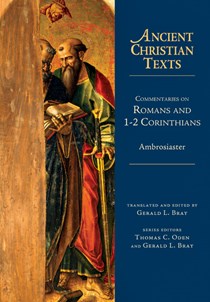 Hardback
Commentaries on Romans and 1-2 Corinthians
Ancient Christian Texts
by Ambrosiaster
Edited and Translated by Gerald BrayAmbrosiaster ("Star of Ambrose") is the name given to the anonymous author of the earliest complete Latin commentary on the thirteen epistles of Paul. The commentaries were thought to have been written by Ambrose throughout the Middle Ages, but their authorship was challenged by Erasmus, whose arguments have proved decisive.
Here for the first time Ambrosiaster's commentaries on Romans and ...
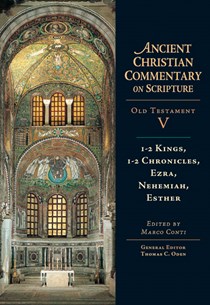 Hardback
1-2 Kings, 1-2 Chronicles, Ezra, Nehemiah, Esther
Volume 5
Ancient Christian Commentary on Scripture
Edited by Marco Conti
General Editor Thomas C. OdenThe church fathers, as they did in earlier books dealing with Israel's history from the time of Joshua to the united monarchy, found ample material for typological and moral interpretation in 1-2 Kings, 1-2 Chronicles, Ezra, Nehemiah and Esther. It will be immediately clear to readers of this volume that they gave much more attention to 1-2 Kings than to others; whether this was ...


