

Search Results
Showing 81 - 90 of 595 results
-
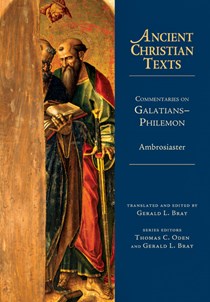 hardcover
Commentaries on Galatians--Philemon
Ancient Christian Texts
by Ambrosiaster
Edited and Translated by Gerald BrayAmbrosiaster ("Star of Ambrose") is the name given to the anonymous author of the earliest complete Latin commentary on the thirteen epistles of Paul. The commentaries were thought to have been written by Ambrose throughout the Middle Ages, but their authorship was challenged by Erasmus, whose arguments have proved decisive.
The commentaries, which serve as important witnesses to pre-Vulgate ...
-
 paperback
1-2 Kings, 1-2 Chronicles, Ezra, Nehemiah, Esther
Volume 5
Ancient Christian Commentary on Scripture
Edited by Marco Conti
General Editor Thomas C. OdenThe church fathers, as they did in earlier books dealing with Israel's history from the time of Joshua to the united monarchy, found ample material for typological and moral interpretation in 1-2 Kings, 1-2 Chronicles, Ezra, Nehemiah and Esther. It will be immediately clear to readers of this volume that they gave much more attention to 1-2 Kings than to others; whether this was ...
-
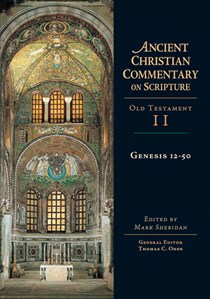 hardcover
Genesis 12-50
Volume 2
Ancient Christian Commentary on Scripture
Edited by Mark Sheridan
General Editor Thomas C. OdenGenesis 12–50 recounts the history of the patriarchs—Abraham, Isaac, Jacob, and Joseph. From their mentors Paul, Peter, Stephen, and the author of the letter to the Hebrews, the early fathers learned to draw out the spiritual significance of the patriarchal narrative for Christian believers. The Alexandrian school especially followed Paul's allegorical use of the story of Sarah ...
-
 paperback
Genesis 12-50
Volume 2
Ancient Christian Commentary on Scripture
Edited by Mark Sheridan
General Editor Thomas C. OdenGenesis 12–50 recounts the history of the patriarchs—Abraham, Isaac, Jacob, and Joseph. From their mentors Paul, Peter, Stephen, and the author of the letter to the Hebrews, the early fathers learned to draw out the spiritual significance of the patriarchal narrative for Christian believers. The Alexandrian school especially followed Paul's allegorical use of the story of Sarah ...
-
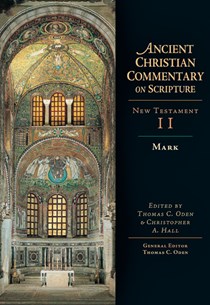 hardcover
Mark
Volume 2
Ancient Christian Commentary on Scripture
Edited by Christopher A. Hall
General Editor Thomas C. OdenChristianity Today Book Award Winner
The early church valued the Gospel of Mark for its preservation of the apostolic voice and gospel narrative of Peter. Yet the early church fathers very rarely produced sustainedcommentary on Mark. This brisk-paced and robust little Gospel, so much enjoyed by modern readers, was overshadowed in the minds of the fathers by the magisterial ...
-
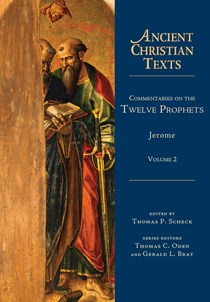 hardcover
Commentaries on the Twelve Prophets
Volume 2
Ancient Christian Texts
by Jerome
Edited by Thomas P. ScheckJerome (c. 347-419/20), one of the West's four doctors of the church, was recognized early on as one of the church's foremost translators, commentators, and advocates of Christian asceticism. Skilled in Hebrew and Greek in addition to his native Latin, he was thoroughly familiar with Jewish traditions and brought this expertise to bear on his understanding of the Old Testament. Beginning in 379, ...
-
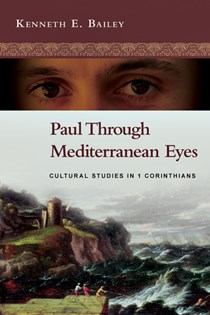 paperback
Paul Through Mediterranean Eyes
Cultural Studies in 1 Corinthians
by Kenneth E. Bailey
Christianity Today Book Award winner
Paul was a Hebrew of the Hebrews, steeped in the learning of his people.
But he was also a Roman citizen who widely traveled the Mediterranean basin, andwas very knowledgeable of the dominant Greek and Roman culture of his day. These two mighty rivers of influence converge in Paul's first letter to the Corinthians.
With ...
-
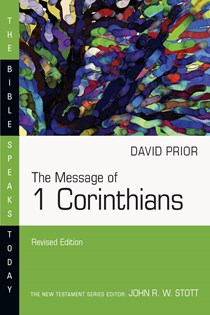 paperback
The Message of 1 Corinthians
The Bible Speaks Today Series
by David Prior
The ancient city of Corinth was well-known for its prosperity, diversity—and debauchery. Any church planted there was bound to have problems. Indeed, snobbishness, divisiveness, insensitivity, doctrinal looseness, and overexuberance were all too common in the Corinthian church. When the apostle Paul heard about these difficulties, he was grieved because he had founded the church ...
-
 ebook
ebookBeauty, Order, and Mystery
A Christian Vision of Human Sexuality
Center for Pastor Theologians Series
Edited by Todd A Wilson and Gerald L. Hiestand
Humans are sexual creatures.
Our sexuality can be a beautiful and mysterious expression of what it means to be human. But it can also become distorted and sinful.
Perhaps no issue is as urgent for the church today, orconfronts it with as many questions, as human sexuality: What does it mean to fulfill God’s will through our sexuality? ...
-
 paperback
The Lost World of Adam and Eve
Genesis 2-3 and the Human Origins Debate
The Lost World Series
by John H. Walton
Contributions by N. T. WrightChristianity Today Biblical Studies Award of Merit
For centuries the story of Adam and Eve has resonated richly through the corridors of art, literature and theology. But for most moderns, taking it at face value is incongruous. And even for many thinking Christians today who want to take seriously the authority of Scripture, insisting on a "literal" understanding ...


